


Table of Contents
Few things send a Chihuahua owner reaching for the bathroom scale faster than a tiny dog who looks a little rounder this month, or a puppy who still fits in one hand at twelve weeks. Chihuahua weight can feel like a moving target, especially when these little dogs arrive in such a wide range of shapes and sizes. If you have ever wondered whether your dog is too small, too big, or growing right on schedule, you are in good company.
This guide gives you a friendly reference point for healthy development, from those first wobbly newborn weeks all the way to full-grown adulthood. The numbers below work as a general map, not a verdict on your dog. Real Chihuahua weight depends on genetics, body structure, diet, and overall health, so a little variation here is completely normal and usually nothing to worry about.
Quick answer: Most adult Chihuahuas weigh around 2 to 6 pounds, though some healthy pet Chihuahuas may fall outside that range depending on genetics, body structure, diet, activity level, and overall health. Puppy growth can vary, so weight charts should be used as a general guide rather than a strict rule. If a Chihuahua is losing weight, gaining weight quickly, refusing food, or looking unusually thin or heavy, a veterinarian can help evaluate their health and body condition.
Typical Chihuahua Weight Ranges
The breed standard sets a clear expectation for show dogs. According to the AKC Chihuahua breed standard, a Chihuahua should not weigh more than 6 pounds. That gives most adults a typical range of about 2 to 6 pounds.
When people picture a typical Chihuahua weight, that 2 to 6 pound range is the anchor most owners start from. Plenty of beloved pet Chihuahuas land a bit above that line, and many of them are perfectly healthy. A sturdy 7 or 8 pound Chihuahua with a defined waist and good energy is often in better shape than a 4 pound dog carrying extra padding. Adult Chihuahua weight tells you something useful, but body structure and condition fill in the rest of the picture.
Chihuahua Puppy Growth Stages
Chihuahua puppies pack a lot of change into their first year. Chihuahua weight rises quickly in those early weeks, then settles as the first birthday approaches. Here is how that journey usually unfolds.
- Newborn (birth to 2 weeks). Puppies are tiny, eyes closed, and fully dependent on mom. Healthy newborns gain a little each day, which is one early sign that nursing is going well.
- Transitional (3 to 4 weeks). Eyes and ears open, and those first wobbly steps appear. Weight starts climbing more noticeably.
- Socialization (5 to 8 weeks). Puppies become curious and playful, often doubling in size during this window as they begin weaning onto soft food.
- Juvenile (2 to 6 months). This is the fastest growth phase, where most of the visible size change happens.
- Approaching adult (6 to 12 months). Growth slows down, and many Chihuahuas reach close to their final adult weight somewhere between nine and twelve months.
Chihuahua Weight Chart by Age
Use this Chihuahua weight chart as a gentle reference, not a diagnosis tool. Growth varies widely based on genetics, litter size, nutrition, health, and whether a puppy comes from smaller or larger lines. A pup who tracks a little under or over these ranges can still be perfectly healthy.
| Age | General Weight Range | What Owners May Notice |
|---|---|---|
| Birth to 2 weeks | About 2.5 to 5.5 oz | Steady daily gain; sleeps and nurses most of the time |
| 3 to 4 weeks | About 4 to 10 oz | Eyes open, first steps, more alert |
| 5 to 8 weeks | About 8 oz to 1.3 lbs | Playful, weaning onto soft food, rapid change |
| 2 to 3 months | About 1 to 2 lbs | Energetic, curious, growing quickly |
| 4 to 5 months | About 2 to 3.5 lbs | Leaner, leggier “teenager” stage |
| 6 to 8 months | About 3 to 5 lbs | Growth slows, body starts to fill out |
| 9 to 12 months | About 3.5 to 6 lbs | Close to adult size for many dogs |
| Adult Chihuahua | About 2 to 6 lbs (some healthy pets larger) | Stable weight, settled body shape |
Some owners like to estimate adult size from a puppy’s weight at around fourteen to sixteen weeks, then roughly double it. That trick can be fun, though it stays an estimate, since lines and individual development differ so much.
This following chart works like a growth tracker. Each column stands for a possible full-grown adult weight, and each row is an age. Weigh your puppy every week or two and notice which column their weight lines up with. When they keep landing in the same column, that column usually points to their full-grown adult Chihuahua weight, shown in the highlighted 18-month row at the bottom.
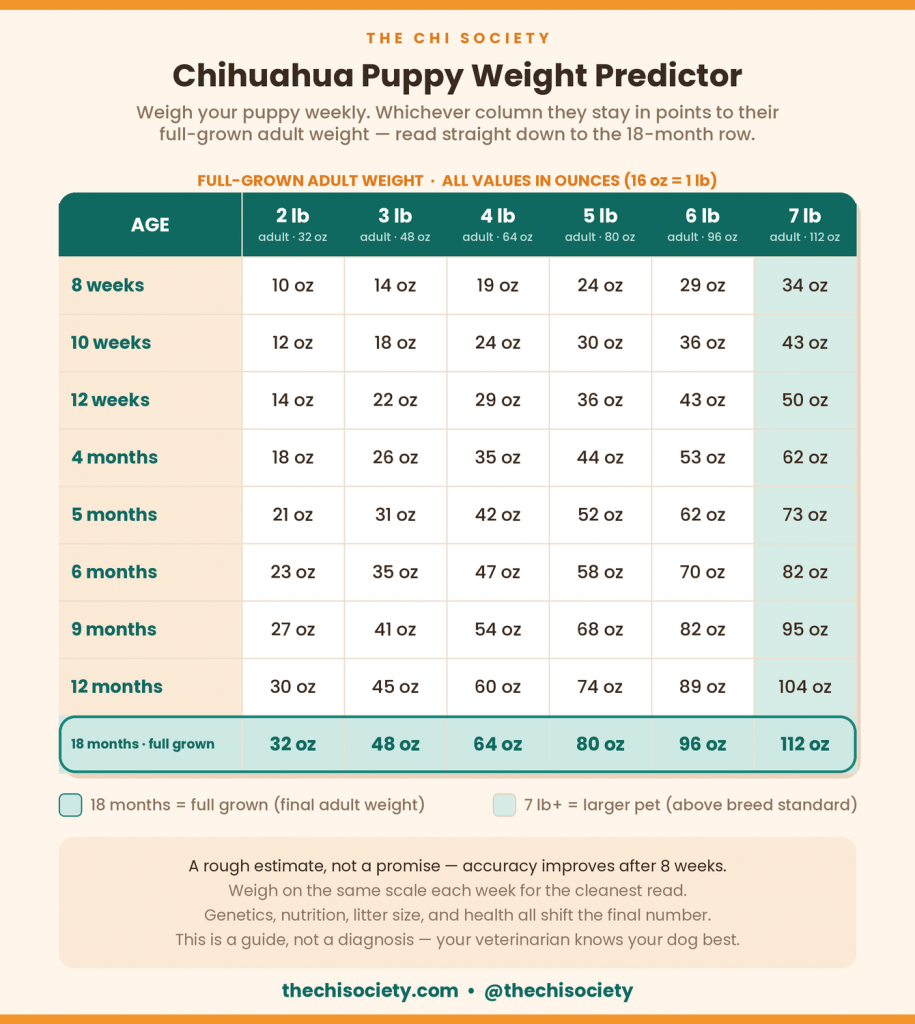
All cell values are in ounces (16 oz = 1 lb). Column headers show the full-grown adult weight.
A few honest caveats before you lean on the number. These figures are estimates that get more reliable after eight weeks, since very young puppies often look heavier from rich milk and little exercise. Weigh on the same scale each time for the cleanest read. An adult Chihuahua weight above 6 pounds sits over the breed standard, yet a sturdy 7-pound pet can be perfectly healthy. Genetics, nutrition, litter size, and health all move the final result, so treat the grid as a friendly prediction.
Factors That Affect Chihuahua Growth
Two Chihuahua puppies from different litters can grow on very different timelines, which means Chihuahua weight rarely follows a single rulebook. A few things shape where a dog lands.
- Genetics and breeding lines. Smaller-boned parents tend to produce smaller pups, while larger lines produce stockier dogs.
- Litter size and birth weight. A puppy from a big litter may start smaller and catch up later.
- Nutrition. Balanced, age-appropriate food supports steady Chihuahua weight gain without pushing a puppy to grow too fast.
- Overall health. Parasites, dental issues, or illness can slow growth in some dogs and deserve a veterinary look.
- Spay or neuter timing. This can have a mild influence on metabolism and adult body composition.
If you are still fine-tuning portions, our guide on how much food a Chihuahua should eat pairs nicely with the chart above. Owners curious about the wider size spectrum often enjoy reading about the biggest Chihuahua breed and the different types of Chihuahuas, since lines and head type can hint at adult build.
When a Chihuahua May Be Underweight
A Chihuahua who looks a little slim is not automatically in trouble. A naturally lean Chihuahua weight, on its own, is rarely a cause for alarm, and some healthy dogs are simply built that way. There are a few signs that may be worth a closer look.
- Ribs, spine, or hip bones that feel very sharp or look prominent
- A sudden drop in weight over a short period
- Low energy paired with a smaller appetite
- A coat that looks dull or thin
Puppies have less fat reserve than adults, so an underweight Chihuahua puppy can lose ground quickly. Low blood sugar is one possible concern in very small or very young dogs. If your Chihuahua seems unusually thin, it may help to have a veterinarian assess body condition and rule out anything medical.
When a Chihuahua May Be Overweight
Extra weight is common in small breeds, partly because a few stray treats go a long way on a 5 pound frame. Tracking Chihuahua weight over the months helps you spot a slow climb before it turns into joint or heart strain. Carrying too much can add strain to tiny joints, the back, and the heart over time. For dogs hauling a little extra, small home tweaks like pet stairs can spare those joints, and our roundup of small dog safety products covers a few worth a look. The AVMA shares guidance on the health effects of excess weight in pets, which is worth a read for any small-dog owner.
Signs a Chihuahua may be carrying extra weight can include:
- Ribs that are hard to feel under a layer of padding
- A waist that disappears when you look from above
- A rounded, full belly with no visible tuck from the side
- Reluctance to move, jump, or play as much as usual
The goal is never a crash diet. Quick, dramatic weight loss can be risky for a small dog. Gentle portion adjustments and a steady walking routine, guided by your veterinarian, tend to work better than drastic changes. Our 10 health tips for a long, happy Chihuahua cover several easy habits that support a healthy weight.
A quick word on “teacup” marketing. There is no separate teacup breed, only very small Chihuahuas, and the label can set unrealistic expectations about how tiny a healthy dog should be. Body condition matters far more than chasing a number on the scale.
How to Monitor Your Chihuahua’s Body Condition
You do not need fancy equipment to keep an eye on body condition. A weekly hands-on check, plus a quick note of your Chihuahua weight, tells you more than the scale alone. The body condition scoring approach used by VCA Hospitals is a helpful framework.
Signs a Chihuahua may be at a healthy weight:
- Ribs can be felt with light pressure, like the back of your hand
- A visible waist when you look down from above
- A tucked abdomen when viewed from the side
- Good energy level for their age
- A steady, predictable appetite
- Easy, comfortable movement
Possible signs to discuss with a veterinarian:
- Ribs, spine, or hips that look or feel very prominent
- Sudden weight loss or rapid weight gain
- Difficulty walking or jumping
- Low energy or reduced appetite
- Constant hunger alongside weight changes
- A potbelly appearance in a puppy
- Coughing, vomiting, diarrhea, or other symptoms paired with weight changes
A simple kitchen scale or pet scale can help you track Chihuahua weight at home between vet visits, especially for puppies and seniors where small changes matter most.
When to Call a Veterinarian
This article is for general educational purposes and is not a substitute for professional advice. Charts and checklists give you a starting point, and your veterinarian can read the full story of your individual dog.
Consider contacting a veterinarian if you notice sudden weight loss, rapid weight gain, refusal to eat, repeated vomiting, diarrhea, weakness, collapse, trouble breathing, pain, lethargy, or any other change that feels off. For very young or very tiny Chihuahuas, it is wise to act quickly, since small dogs can go downhill faster than larger breeds. A simple record of your Chihuahua weight over time gives your vet helpful context, and asking them to assess body condition at routine visits is one of the easiest ways to stay ahead of any concern.
The Chi Society Takeaway
Your Chihuahua’s worth was never measured in pounds. A weight chart is simply a tool that helps you notice trends early and keep your little one comfortable for years to come. Watch the whole dog in front of you, the bright eyes, the easy movement, the happy appetite, and let the scale play a supporting role. When something genuinely shifts, you will be glad you were paying attention to Chihuahua weight all along.
Join The Chi Society Pack
Join The Chi Society Pack for free to get Chihuahua stories, tiny-dog tips, rescue updates, product picks, and community questions sent straight to you.
Frequently Asked Questions
How much should a Chihuahua weigh as an adult?
Most adult Chihuahuas weigh around 2 to 6 pounds, in line with the breed standard. Some healthy pet Chihuahuas weigh a little more, and body condition matters more than hitting an exact number.
Is my Chihuahua puppy growing at a normal rate?
Puppy growth varies a lot between litters and lines. A puppy who tracks slightly above or below a Chihuahua weight chart can still be healthy. Steady, gradual gain is the reassuring pattern to look for, and your veterinarian can confirm whether development is on track.
How can I tell if my Chihuahua is overweight?
Alongside checking Chihuahua weight, you may be able to feel for the ribs and look for a waist from above and a tucked belly from the side. Ribs that are hard to feel and a missing waistline can suggest extra weight. A veterinarian can give you an objective body condition assessment.
What is a healthy Chihuahua weight for a teacup Chihuahua?
There is no official teacup breed, only very small Chihuahuas. The same 2 to 6 pound range applies, and extremely tiny dogs may need extra care around blood sugar and fragility. Healthy structure matters more than chasing the smallest possible size.
When should I worry about my Chihuahua’s weight?
Reach out to a veterinarian for sudden Chihuahua weight loss, rapid weight gain, refusal to eat, or weight changes paired with vomiting, diarrhea, low energy, or other symptoms. Quick changes in a small dog are always worth a professional look.

